Clear aligner treatment in Thrissur
The modern pathway: custom, removable, nearly invisible trays, planned digitally by a specialist orthodontist.
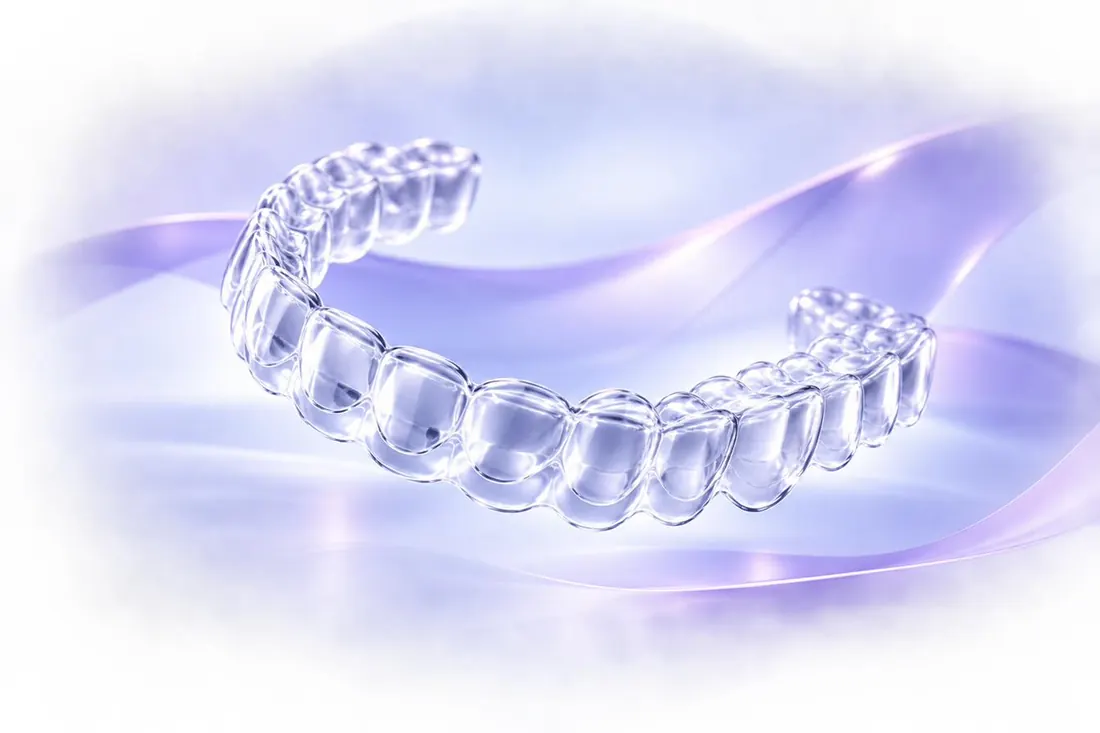
Clear aligners are a series of thin, transparent, removable trays. Each one is shaped slightly differently, and together they move your teeth gradually into place.
How they look
Nearly invisible. They’re made from clear medical-grade plastic that fits snugly over your teeth. Small tooth-coloured bumps called attachments may be bonded to some teeth to help the aligners grip and move them precisely.
How they work
Your teeth are scanned in 3D, and I plan every movement on screen before treatment begins. Each aligner moves your teeth a fraction of a millimetre, and you switch to a new set every 7–14 days. You see a preview of your final smile before you start.
Living with them
Wear them 20–22 hours a day. Take them out to eat, to drink anything other than water, and to brush. Most people adapt within a few days.
What makes mine different
I plan every case myself, with no automated setups, and the aligners are made in my own in-house aligner unit. If a tooth needs extra help, refinements are made quickly, without waiting on an outside lab.
Options
- Aligners from my in-house unitPlanned and made under my supervision, from scan to final tray.
- InvisalignI’m a certified Invisalign provider.
- ClearCorrectI’m a certified ClearCorrect provider.
- SparkI’m a certified Spark aligner provider.
What are clear aligners?
Clear aligners are custom-made, removable, transparent trays. Each tray moves your teeth a small step towards a digitally planned position. You change trays on a schedule set by your orthodontist and wear them about 20 to 22 hours a day.
How they move teeth
Every tray differs slightly from the last, so it presses gently on the teeth that need to move. Small tooth-coloured bumps called attachments may be bonded to some teeth to help the tray grip and control movements such as rotations. Sometimes a little enamel is polished between teeth (interproximal reduction) to create room.
Why a specialist plan matters
Software shows the planned end-point. A specialist decides whether that plan is biologically realistic, which teeth need attachments, and when a case is better treated another way.
Often a good fit
- Mild to moderate crowding or spacing
- Adults and older teenagers whose growth is complete
- People who can wear trays most of the day
- Cases where treatment without extractions is suitable
May need braces or another approach
- Marked rotation of rounded teeth such as canines and premolars
- Teeth that need to be pulled down (extrusion)
- Larger front-to-back or vertical jaw discrepancies
- Cases needing extraction-space closure or major bodily movement
Eating and drinking
Take trays out for meals and for hot or sugary drinks. Brush before putting them back so food is not trapped against your teeth.
Cleaning
Rinse and brush trays gently every day using cool water. Keep them in their case when out, never wrapped in a tissue.
Comfort
Mild tightness for a day or two with each new tray is common and settles. Persistent pain or a tray that no longer fits should be reviewed.
After aligners: retention
Teeth tend to drift back towards where they started, so almost everyone needs some form of retainer after orthodontic treatment. The type and duration are chosen for your case.
References
- Papadimitriou A, Mousoulea S, Gkantidis N, Kloukos D. Clinical effectiveness of Invisalign® orthodontic treatment: a systematic review. Prog Orthod. 2018;19:37. PubMed · DOI
- Rossini G, Parrini S, Castroflorio T, Deregibus A, Debernardi CL. Efficacy of clear aligners in controlling orthodontic tooth movement: a systematic review. Angle Orthod. 2015;85(5):881–889. PubMed · DOI
- Zheng M, Liu R, Ni Z, Yu Z. Efficiency, effectiveness and treatment stability of clear aligners: a systematic review and meta-analysis. Orthod Craniofac Res. 2017;20(3):127–133. PubMed · DOI
Are aligners right for you?
A short consultation is the only reliable way to know. We will show you the options honestly.
Book a Consultation